

Making sense of the risks we face
Understanding the risks facing our communities should be straightforward. Unfortunately, the systems that produce, manage and communicate this information are anything but.
The world of emergency preparedness and community resilience involves governments, emergency services, scientists, local authorities, community organisations, advocacy groups and individual citizens. All have important knowledge and experience to contribute, but they often work in different ways, use different language and don’t always share information effectively.
Even where common frameworks exist, the differences can be striking.
Take Community Risk Registers. Local Resilience Forums (LRFs) in England and Wales are required to maintain and publish assessments of the risks facing their areas. Yet these registers vary enormously in the information they provide, the methodologies they use, the level of detail they offer and how accessible they are to the public.
Some provide detailed assessments and explanations. Others offer little more than a list of potential hazards. Comparing risks between areas, or even understanding how a particular risk has been assessed, can be surprisingly difficult.
We think this information should be easier to find, understand and use.
Bringing the pieces together
Our Community Risk Explorer is an attempt to bring these disparate sources together into a single, accessible resource.
It allows you to explore the risks identified for different parts of the country, compare assessments and navigate information that would otherwise be scattered across dozens of separate publications and websites.
Importantly, we’re not trying to replace the original assessments. We want to make them more accessible while preserving links to the source material, so anyone interested can dig deeper, understand the evidence and see where the information came from.
We’re also making the differences between assessments more visible, rather than pretending that all the underlying data is equally detailed, consistent or directly comparable.
A starting point, not the whole picture
Community Risk Registers offer a relatively low-resolution view of risk. They describe the broad threats facing large geographical areas, rather than the particular vulnerabilities of an individual street, neighbourhood or home.
Think of them as the zoomed-out view of community risk.
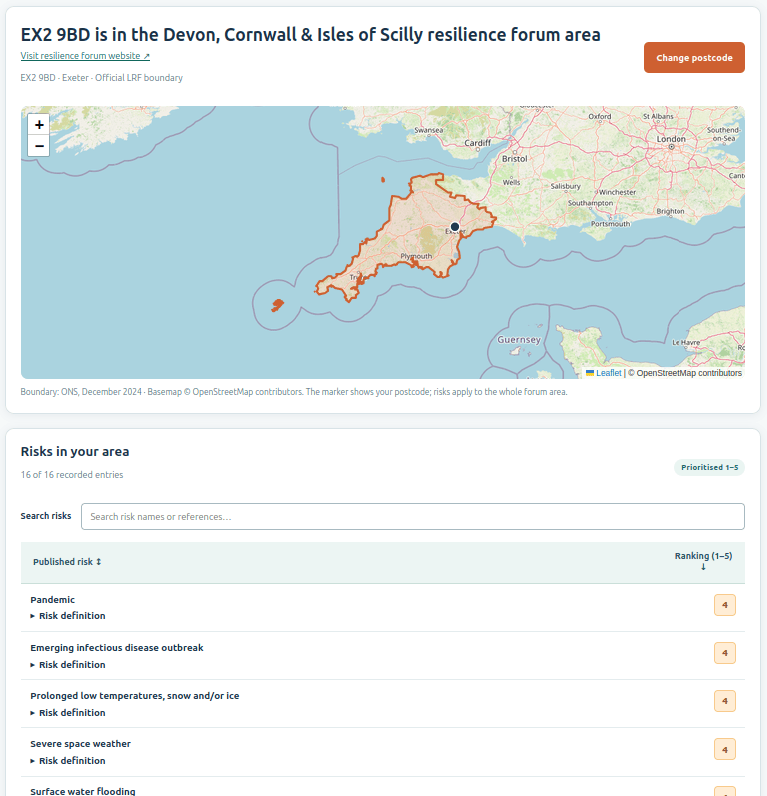
But that makes them a valuable starting point. They provide an established foundation of risk assessments on which we can begin building a more complete and useful picture of the challenges facing communities across the UK.
Our ambition is to move progressively closer to the places and people affected: exploring risks at neighbourhood, street and household levels, and connecting that knowledge to practical actions people can take.
The Community Risk Explorer is our first step towards making risk information genuinely useful to the people who need it.
There’s much more to come.


Leave a Reply